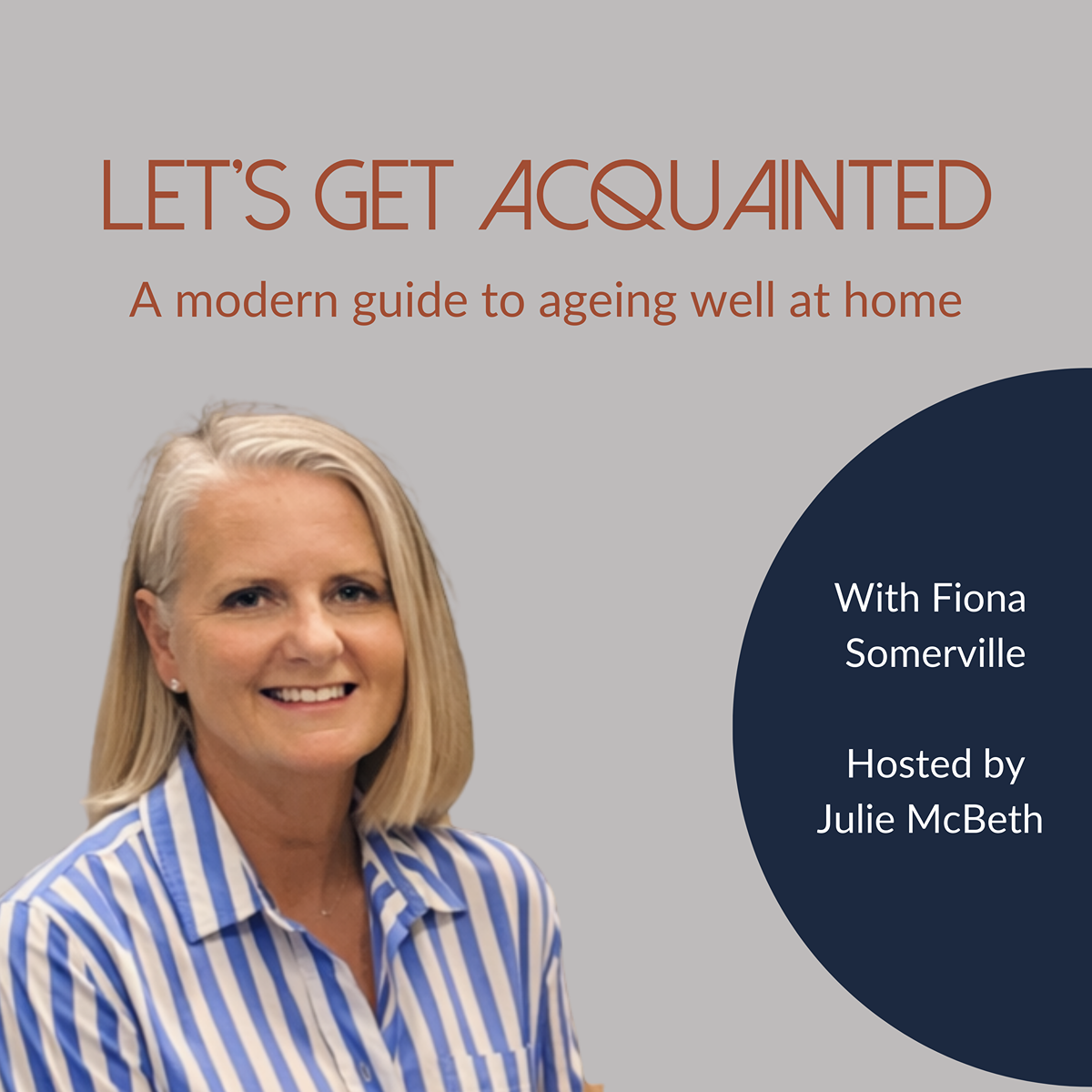
Episode 1: Luxury Care in Your Own Home
Join Fiona Somerville and Julie McBeth as they discuss premium in-home care alternatives to nursing homes and how to avoid making decisions in a crisis.
Most families don’t start talking about ageing, care, and independence until something forces their hand. It sits at the back of our minds during family dinners when we notice a parent moving a little slower or forgetting small things, but we tell ourselves, "Not yet, we’ve got time". Then, time runs out. Whether it’s a fall or a sudden diagnosis, enormous decisions about independence are suddenly made in a state of panic.
In the first episode of Let’s Get Acquainted, host Julie McBeth speaks with Fiona Somerville, Managing Director of Acquaint. With over two decades in nursing and business, Fiona believes we could use a different approach. Rather than waiting for an emergency room doctor to tell you what comes next, this episode explores how to stay in control and build care around the life you actually want to keep living.
Why families wait for a crisis
We often delay these talks because we like to think our parents are pretty infallible. Parents often put on their best behaviour when the kids come for dinner to avoid dealing with the reality of their struggle. It’s confronting to realise the person you’ve always looked up to might finally need you to lead, but by waiting, you’re forced to react under pressure rather than planning with clarity.
The problem with the default answer
In a crisis, families look to experts, GPs or hospital staff, who often provide a standard default answer: move to a nursing home. Fiona calls this the Henry Ford approach to care: you can have any colour as long as it’s black. For many, this not always the best option because it means leaving the garden and the home behind for a facility where you won't get the one-on-one (or even two-on-one) support you can have right now in your own lounge room.
A purely private, high-touch model
Acquaint was born from a gap in the market for people who are unapologetically looking for something better than the bureaucratic norm. Fiona explains that being purely private allows Acquaint to skip the jargon and the 47-page Centrelink forms. Instead of a press one for this, press two for that experience, this model is about listening first and delivering a service that is purely private and really high touch.
Care that actually matches the person
One of the most compelling parts of the conversation is how Acquaint matches carers to clients. Clinical skills are a given, but true premium care is about the personality match. Older people don't stop being themselves as they age. Whether a client is a big meat-eater who needs someone to cook a fresh stir-fry, or a little fashionista looking for a match made in heaven, good care recognises the person’s history and passions.
The Neil Diamond philosophy
One story captures the heart of this approach: a client who started with simple companionship, literally dancing around the lounge room to Neil Diamond while his wife had a bit of respite. Acquaint cared for him through every stage until his last breath, ensuring he remained the CEO of the house in the place he loved most.
View the full transcript: Episode 1
Welcome to Let's Get Acquainted, a modern guide to ageing well at home. It's a conversation most of us are avoiding. It sits at the back of our minds during family dinners when we notice our parents are moving a little slower, forgetting small things or struggling with tasks that used to be second nature.
We tell ourselves, not yet, we've got time, we'll be fine. And then one day time runs out. Might be a fall or a diagnosis or a sudden crisis.
And we're making an enormous decision about care, about home, about independence, all while in a state of panic. What if there was a better way? I'm Julie McBeth, your host, and welcome to the first episode of Let's Get Acquainted, a modern guide to ageing well at home. Today I'm speaking with Fiona Somerville, Managing Director of Acquaint, a premium in-home aged care service that's rethinking what it means to age well at home.
Fiona spent time over two decades in nursing and aged care and other amazing roles, and she believes we're approaching this entire conversation in a way that needs to be rethought out. So, Fiona, welcome. Thank you.
I'm very excited to be here.
Why do you think so many families wait until there's a crisis before they start thinking about aged care? I think we all think that we're pretty bulletproof in reality, and we also like to think that our parents are pretty infallible as well. So, it's not until really when something really starts to be very noticeable that we think that there's anything that we need to get concerned about.
I mean, we always hear about people who go back home for dinner or something, and they turn into the kid. They could be in their 50s or 60s, but you go to mum's for dinner, and you're the kid again, because you're obeying their rules in their home. That is part of it, isn't it? You're used to your parents directing you, not the other way around.
Yeah, and it's quite confronting when all of a sudden you need to be directing somebody else that you've always looked up to and admired and thought, you're the strong person in this relationship. I know that some parents out there too, they do want to be seen as infallible to their kids. They don't want their children to think they might be struggling or that they might be forgetting things.
So, when you go around for dinner, maybe they're putting on their best behaviour to kind of avoid having to deal with it as well. Absolutely, and we see that with clients. They're founders of incredibly successful businesses.
They're still going to board meetings. They're still actively involved. They may not actually be running that business, but it's really important to them and it's really important to their family that they still be involved in that day to day or even occasional oversight and things like that, because it was their baby.
Absolutely, and none of us want to actually think we're getting older, do we? Oh God, no. I'm not. You might be.
No, I'm definitely not. I guess that's what it is. So, as you get older, and if we think about it ourselves, we always think we're a bit younger and more capable.
At least 15 years younger than we really are. Exactly, and so when people think, yes, I can get up that ladder and do something, and then all of a sudden there's a fall. They're in emergency.
They've gone beyond what their actual capabilities are, beyond their limits, and that's when the conversation starts, because they might need that bit of help. They might be in their home alone. They might not have their partner may have passed or they could be on their own, but what are the decisions then, when you're in that state of emergency, where families are forced to make those decisions, how does that sort of work for most people? Yeah, that can be a really scary time, actually, because people are looking to the experts wherever they are, whether it's at the GP clinic or if it's in the hospital emergency room or they've had a visit to aged care and they're in respite, and somebody's sitting there saying, mum needs to go into aged care, which is the default answer.
We get told that so many times. We've had clients that we supply 24-hour care seven days a week and something might happen and they've had a medical episode and they're in hospital and the hospital's telling the family, oh no, they need to go to a nursing home, and it's like, well, you've got one-on-one and in fact sometimes two-to-one care staff in your home and you're not going to get that ratio when you move into residential aged care. So for them, that was not the ideal option for them and it was an option they were never going to take.
I guess none of us want to leave our home behind either. No, do you? No. No.
So it's one of those things where people, I can imagine medical professionals saying, well, you've got to go to a home now, but you're thinking, well, what about my garden? Yeah, and I think in hospitals often, and particularly maybe more so in the public sector, and this is certainly not a criticism of them, but people in the public sector where really motivated to save money. So we always look at what's the most affordable option for somebody rather than, well, this person might be able to pay for something, and they haven't got that, they're not given those options. So that's what we see all the time is that people have been given kind of the standard default, here's what everybody gets.
It's a bit like Henry Ford, you can have any colour car as long as it's black. It's kind of, well, no, you can't. You don't have to.
You actually can have something of your own choosing and your own determination. Which leads us into a quaint, and why is a quaint here? Well, there's a huge gap in the market, to be quite frank. I've consulted to the aged care industry nationally for many years.
I've seen the good, the bad, the ugly all over the country. I've seen government funded services, and then I see people, friends, family, colleagues, all sorts of people that I know that just used to be so frustrated with the system, but also at a higher level of wealth were being asked to contribute so much more to services and really not getting what they needed out of those services. So, happily prepared to pay to stay at home and people saying, there is no way I'm moving into aged care, that's their choice.
But there wasn't a pure choice out there in the market. There's a lot of companies that provide government funded services and then say that they do private on top of that, but you still get that same experience of press one for this, press two for that. All the government jargon when you call, a lot of the similar forms, the whole experience is very bureaucratic.
Totally bureaucratic. And people are wanting better or wanting different. So, a purely private service that is really high touch, that actually listens to people.
When people call us, we're actually asking questions more than we're trying to sell ourselves. We're finding out about what people want and then we can have discussions with people about how we can meet their needs. So, rather than, here you need to do this, have you got this form, have you done this, XYZ, have you filled out your 47 page Centrelink form, we don't do that.
We actually listen to what our clients want and then we deliver on that. And you are at a niche as well where you're looking after people who are- Unapologetically, yeah, totally. Who are perhaps in that upper bracket, but it's still a service that people who plan, like they plan for their retirement, they can access that as well.
Yeah, well, people plan or they don't plan. So, we get clients that will ring and say, yes, we're starting to need a little bit of help around the house and that's great. And we love it when people do start to plan early and we've seen many clients where we've started with exactly that.
I think I joke sometimes, we had a client that we did start off literally dancing around the lounge room to Neil Diamond and keeping him company while his wife had a little bit of respite and got out and did some things that she needed to do. It didn't have to worry about him being alone in the house. He was a falls risk amongst other things.
And we looked after him all the way through to his last breath, which was a great honour to be able to do that. And he was able to stay at home, which is where he wanted to be. And that's really important.
Fantastic. So, I might just go back to your own background. You started out in nursing, didn't you? I did, about a thousand years ago.
Yes, I did my nursing at St Vincent's in Melbourne. So, I had some fantastic years there, great memories. I'm actually currently on the Nurses Alumni Committee, so that's a lot of fun and getting together people for some really fantastic events to celebrate nursing and also put back into the nursing community and help, you know, I guess support and foster the next generation of St Vincent's nurses, which is really great fun.
That's great. And you're coming from that background where caring for others has sort of always been part of your role. Yes.
I've also worked in organisations that have been very commercially focused and very entrepreneurial. So, many years ago worked for a very large organisation that was owned by what I can only describe as a true entrepreneur. And it was really exciting, but the owner gave us the opportunity to do really amazing stuff.
If we could put forward a good business case and he would back us to the hilt, which was really fantastic. And I was studying my MBA at the time, so it was probably the beginning of me looking at how do we do things differently. I was then invited to go work, I worked in financial services for a short time, but I was then invited to go join a large aged care group at a time when they were going through an acquisition, one of their first of many, many.
And I was, I guess they created a role for me and that was really fantastic. And I was there for a little while, a couple of years, and then had a management consultancy that consulted to the aged care industry. Again, saw a gap, plenty of aged care consultants out there, not a lot that really impressed me from a business point of view.
And so we thought, look, there's got to be a better way of doing this. And I had that consultancy with a colleague who was absolutely brilliant and we had a really fantastic time working with organisations all around the country from Two Men and a Cat and Outback WA to listed organisations and what have you. So then another private home care business, but a quaint is actually purely private, which is really, really nice.
And I think the difference is that we're staying pure to the kind of clientele that we want to support. I'm all for all the aged care funding and I wish there was a whole lot more. I know the government has got finite resources and there are people that can afford to pay for services.
I don't think everybody needs to go down the government path. And for every client that works with us, I guess the nice thing is we're probably freeing up some supported home funding for people that may genuinely not have access to that. Absolutely.
Yeah. I think that that's, it's so interesting because, as you say, you can get caught up in the government is giving me some free stuff over here. But if you have the means, it's avoiding all that red tape.
It's getting access to the help you need pretty much straight away. And the government funding, as I said before, we have got limited resources and the funding is capped. And when I look at how much people are contributing to the cost of care, if they're self-funded or part-funded retirees, or how much the government funded providers are now charging people, you're not going to get many hours of care out of a government package.
It's never going to be enough to really keep you at home long term. It might be enough, you know, maybe to stave off things for a year or so. But when you're looking long term, I really want to stay at home.
And we've kept people at home, you know, on as little as three, six hours a day of care for a really long time, for a number of years, and in fact, avoided aged care. Now, that's not the same for everybody. But we've been able to do it.
We've had other clients, of course, that have 24-hour care or 10-hour days or sleepovers or whatever it might be. But because everybody is different, and I think that's the difference, is that we can look at things and we can tailor. We can up and down really easily.
You know, there's no government form to fill out to have a reassessment to get you the money that maybe you'll get, maybe you won't. You know, it's, okay, what do you need? How do we help you? Do we need to dial up services? Hey, guess what? You're getting better after your hospital stay or whatever it might be. Let's rack things back.
So we're really flexible in that regard. I think we get to make choices, and I think everything else in life, we get to choose. You know, if I want to eat, I don't know, a whole bowl of hot chips, I can eat them.
Or I can eat one or two, but I've got that choice. So why shouldn't I have that choice when it comes to services that I have? Or if I have a cleaner? So if I have a cleaner in my home, I could have a cleaner once a month, or I could have a cleaner once a fortnight, or I could have a cleaner once a week. I get to choose.
I'm not being dictated to, because I'm choosing to do that. We have clients, they go to the hairdressers twice a week. That's their choice.
Yeah, and you take them to different things. Oh, we're taking people out all the time to wonderful things, to concert recitals and out for lunch and doing all sorts of things. But we take people out of aged care homes that are living in aged care, and we might give them, the families have said, we'd really like mum to get out a couple of times a week, or every single day, or whatever it might be.
And we've got them out and still engaging with their community, so they get the best of both worlds. So I guess while we are there to support people that do want to stay at home, home is wherever home is. And I guess the families are trusting you also, because they're the people they love the most, and they want them to have that care.
You have this amazing way of determining who's looking after who. It's not just a one-size-fits-all. Yeah, well, we need that level of trust.
I mean, we're being entrusted to go into somebody's home, which is a huge honour. And we've got families that live overseas. We've got a call with a lady later this week.
She lives in the UK. She's the only relative of one of our clients. And so it's really important that she's able to communicate with us really easily, that we can give her feedback, that her aunt is well looked after and really enjoys the company of the staff that we send.
So we get to know people really well before we even send a staff member in through the front door for that very first time. So part of our matching process sits around, well, what are the skills that we need to bring to the table to help support someone living at home? And that can be different for a range of reasons. And then we look at things like, well, what are people's likes and interests? And we've got a new client just recently, and they're from a big agricultural family.
So we're not sending the vegetarian round to the big meat eater, I can tell you right now. But he's missing cooking. And so part of what we're doing when we're going there is also going out shopping with him, not for him, but with him.
And then when we saw him in hospital recently, we said, oh, I really miss my stir fries. And he lives alone, so he hasn't been cooking, and he hasn't been cooking stir fries. Whereas you can get your home delivery service, but you're not getting a home delivery fresh stir fry.
And by the time your Uber Eats arrives, it's not hot and fresh and straight out of the wok, is it? But that's what I love, because I've heard stories also where you've had people who are vegans connected with people who can cook. Oh, the vegan teacher. Yes, she gave us a gold star and an elephant stamp for that one.
She was lovely. And she was a lady who, she was a short-term client. So not only are we doing long-term stuff, but this lady was younger.
She was having cataract surgery. So we had two visits, and we'll probably see her in about 10 years. So we had first eye, picked her up from hospital, stayed overnight, made sure she was fine, cooked her dinner, stayed there with her, left the next morning.
Two weeks later, picked her up from hospital, got her dinner, got her settled, stayed the night, said goodbye. And it was fantastic. And she absolutely loved the staff member that we sent, because we found out enough about her and what was important to her to make sure that we matched up the right people.
I mean, it's just so clear that, you know, ageing shouldn't mean loss of your independence. No. And, you know, where does that belief come from? Because, you know, we are a society that doesn't really respect older people.
Well, I'd like to think that things are changing. I just, you know, I see so many things now, you know, on LinkedIn, or I see articles where people are really embracing ageing and, you know, just enjoying it and really enjoying, you know, I guess the knowledge that, you know, a lifetime of experiences have brought along the way. Absolutely.
The wisdom. Yeah. You know, I think we love old people.
We've got, you know, when we recruit, we recruit older staff. We're happy to take people on. They've got incredible life experience.
So, not only have they got caring experience, but, you know, they might be proficient in a number of languages, or they're really amazing cooks, or they've travelled extensively, or they have the same interests in business, or they can sit there and talk about the stock market, or they're heavily involved, you know, one staff member comes to mind, heavily involved in the racing industry. So, she works with us, with clients, and like in some instances, you know, we've been able to match people up with her that they've just gone, oh my goodness, we can't believe our luck. People have got an interest in art and things like that.
People who have owned their own fashion house, you know, match them up with the little fashionista, 90 plus year old, and, you know, we've got a match made in heaven. So, it's really important. It's important to understand that, that's right, people don't change as they get older.
They're still bringing all of that experience and their love of different things. Exactly. To the situation.
We have families, and often we get this line a lot, and I love it, because somebody will go, oh, my mum's really difficult, and I always laugh. I go, look, you're not alone. I said, your mum's not difficult.
She just knows what she wants, and we're all going to be the same. We'll be worse. Of course we will.
Why shouldn't we know what we want? Exactly. So, if families listen to this, and they're just starting to think about ageing and care, what's the one thing you would want them to know? That they can actually take control. They can take control and do things their way, to quote Frank Sinatra.
Really, they can. You know, if you really want to, you can do, if you really want to and you have the means, you can do whatever you like. So, sometimes we've got people that might start off, you know, what they might consider early with services, and we just say to them, look, you're CEO of the house.
You call the shots. So, we're going to work with you, and we're going to do what helps you to enjoy living in your home. So, whatever's going to fit in with the household and your lifestyle, that's where we're here to help.
And sometimes people start, and then after a few visits, all of a sudden they're realising, oh, oh, Sally can come and do, would she be able to take me, or could she do this? And then all of a sudden it's like they've actually got a lot more freedom. It's actually quite liberating to start to get help. Yeah, I can imagine that.
And I remember the story of, I think she was a 90-year-old woman who her carer had horses. No, she teaches dressage, and the client used to love riding as a young girl. So, our staff member took her up to the riding academy, and they had the most beautiful day.
I mean, obviously she didn't get on the horse. No, she didn't, but she got to know a few of the horses, and she was so thrilled to be there. Exactly.
Just beautiful experiences and considered care, is what I would call it. It's like really tailored and genuinely directed to make people feel comfortable, and as you say, the CEO of their home and of their life. Our staff and us, we get to know our clients really, really, really well.
And so, we're always kind of thinking ahead of how do we actually enhance someone's life, rather than just tick a box, go in and do this and do that and leave. Well, Fiona, thank you so much for today. It's been great chatting to you.
We hope this conversation has given you something to think about, and perhaps a bit of a nudge to start planning before a crisis forces your hand. In the next episode, we're going to be talking about why families feel overwhelmed by aged care, and what they'd wish they'd known earlier. Hope you can join us for that.
Thanks for listening to Let's Get Acquainted.