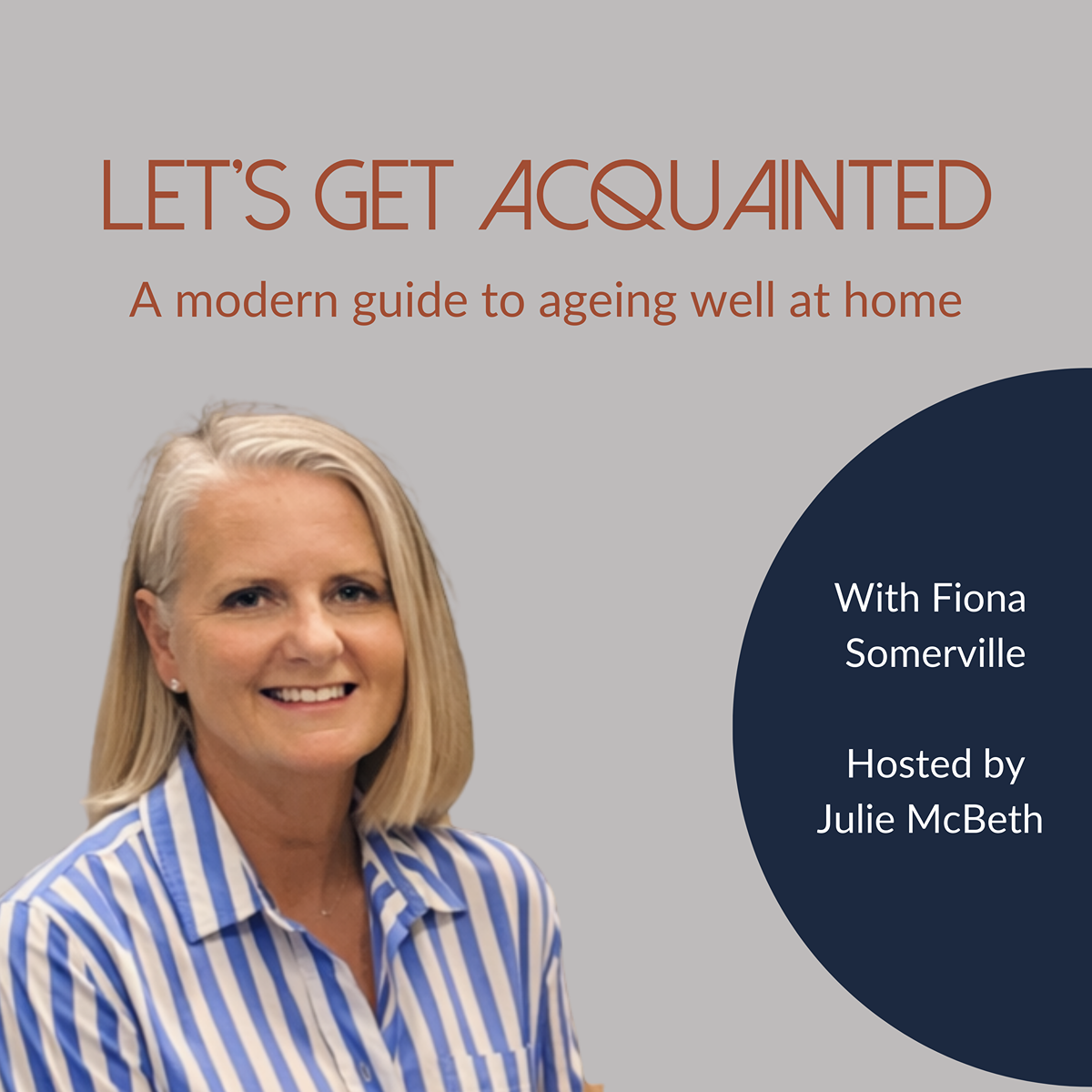
Episode 3: Behind the scenes
Fiona Somerville reveals the Swan Analogy of premium private care. Learn about Acquaint’s hiring ratio, nurse-led oversight, and bespoke carer matching.
When families think about aged care, they usually focus on the visible result. Is their loved one safe? Comfortable? Supported? But those outcomes do not happen by accident; they are created by the people, systems, and standards operating behind the scenes every single day.
In Episode 3 of Let’s Get Acquainted, Julie McBeth speaks again with Fiona Somerville, Managing Director of Acquaint, about what most families never see. From recruitment and staff support to real-time communication, this episode explains why quality care depends on far more than simply sending someone to a home. It is a practical and honest look at what separates rushed, transactional support from thoughtful, premium care designed to run smoothly for everyone involved.
Why great care starts with great people
Care quality starts with recruitment. While the broader sector speaks about staff shortages, Acquaint is inundated with interest. For a single ad on SEEK, they may receive 2,000 applicants and hire only a dozen. Fiona explains that they only take the best, hiring for both skill and specific values: Candid, Smart, Playful, and Kind.
Why rushed visits fail everyone
Fiona describes how some parts of the sector rely on carers being dragged from pillar to post all over Melbourne for half-hour or one-hour visits. This creates stress for staff and dismal outcomes for clients. Acquaint uses a minimum three-hour engagement to ensure carers have time to build rapport, notice subtle changes in wellbeing, and deliver calmer, more human care.
Consistency helps spot early warning signs
When carers spend meaningful time with someone regularly, they notice the small things: a shift in mood, mobility, or memory. These observations lead to earlier interventions or medical follow-ups before a bigger issue develops. As Fiona notes, everyone communicates almost every day to head things off at the pass.
How communication systems support better care
Acquaint uses apps and digital systems to avoid vague handovers like usual day, which Fiona says is unhelpful. Instead, their tech ensures everyone stays informed about:
- Daily preferences, like drinking from a Royal Dalton teacup.
- Personal rituals, such as a specific gin and tonic or avoiding lettuce.
- Scheduling needs, like getting to the Telstra shop to pay a bill in person.
Peace of mind for families overseas
Relatives living in places like Canada or the UK use these communication systems to stay informed. They can leave messages and know their loved one is being looked after, which is just as valuable as the care itself. Unlike other systems where families wait 21 days for a callback, Acquaint addresses messages immediately.
Matching carers to personalities and interests
Premium private care matches people by personality, not just a task list. Fiona describes matches made in heaven, such as:
- A racing enthusiast staff member paired with clients who love race meetings.
- A vegan carer sent to a vegan teacher who gave our service a 10 out of 10 and an elephant stamp.
- Connections based on shared interests in fashion, business, or the arts.
The swan analogy of premium care
Fiona describes premium care as a swan gliding across a lake. On the surface, everything looks calm and effortless. Underneath, there is a mad flurry of feet, coordination, planning, nurse-led oversight, and quality assurance, making that experience possible.
Our job is to make it look like we are the swan, and people don't need to know what's going on in the background.
Great care is rarely accidental. It comes from hiring carefully, communicating constantly, and building systems that allow clients to remain the CEO of the house.
View the full transcript: Episode 3
Welcome to Let's Get Acquainted, a modern guide to ageing well at home. When we think about aged care, we focus on the outcome, whether our loved one is safe, supported and comfortable. What we don't always see though is what's happening behind the scenes.
For example, who's being hired, how carers are supported, how families stay informed and how everything runs day to day. I'm your host Julie McBeth and today we're talking about the people and systems that make good care possible. I'm joined by Fiona Somerville, Managing Director of Acquaint, a premium in-home aged care service that takes a very deliberate approach to the recruitment, assessment and communication when it comes to aged care.
Fiona, welcome back. Today we're going to talk about the importance of carers and we hear all the time in the news about these staff shortages in aged care and it's hard for aged care facilities and people to hire good people, but that's not the case with Acquaint, is it? No, the short answer to that is absolutely not. We get inundated with people wanting to join us.
We get phone calls every day, we get enquiries through our website, we get 2,000 applicants when we have an ad on SEEK. We know that our results are really way up there of people wanting to join us. And so why do you think Acquaint attracts that level of interest? Probably because we're fabulous.
We have staff wanting to come and work with us because we have really fantastic clients. We offer things, I think I touched on in the last episode, we have staff that will work a minimum of three hours, so that's our minimum engagement term with our clients. It's deliberate.
We have the industry where people are being dragged from pillar to post all over Melbourne. An hour here, an hour there. Yes, sometimes half an hour here and an hour and half there.
Varying times and we all know what Melbourne traffic is like as well. But you've also got clientele that are sitting there wondering when somebody is going to turn up and they're racing in the door for an hour's visit and racing out the door. Or they're staying back on their own time, which people think might be quite admirable, but that's not fair to the staff member.
It's also not capturing how much care does this person need to be supported to remain at home. We constantly hear about all these unpaid carer hours in the industry, but also for people looking after their family members as well. There's a huge amount of time that women and men families spend in looking after their elder relatives.
Exactly. If you think about it yourself, you'd rather be somewhere for a few hours than running around, as you say, Melbourne traffic. Just that knowing and understanding that you've got some time to spend with someone.
Exactly. The staff that are attracted to us are very, very heavily invested in supporting our clients to remain living at home in the happiest and most fruitful way that they can. They're 100 per cent dedicated to that.
We're very clear in what we're looking for for our clients. They will often have, in some instances, very particular requirements, and we need to meet them. We've got a lot of interest because we have got clients that have live-in assistants or overnight assistants, typically longer days.
On average, our clients are across the board, maybe roughly around 50-55 hours a week. When you add that up, that's a big investment into staying living at home. For staff, they get very involved and really enjoy the work that they do.
They can see if you're there all day, every day, with somebody, every week. Yes, that consistency. You've got that consistency.
You can notice things. You can follow up with things. There's a lot of small little changes that all of a sudden staff will say to us, I've just noticed since the last time I saw so-and-so, I've noticed X, Y, Z. It's those little things that do make a big difference.
Often, it's the little things that when we're talking to them, and we pretty much talk to everybody nearly every day. That's another thing that's good. We're communicating with them all the time, and they're communicating with us.
So that's really important in really being able to get a handle on things and prevent issues arising and to head things off at the pass or to make changes to support somebody. Sometimes that can be increasing hours of care. Sometimes it can be decreasing as people recover, for example, from a hospital stay or an injury.
I think we have gone through your background also in a previous episode, but it seems to me that the culture of your organisation stems from you and the decades that you've spent in the industry where you've got so much experience understanding how things might be not running well that you've been able to create a quaint in a way that learns from all of those things you learned when you were a consultant or when you were working in industry, and you're able to put that together in a way that is appealing to carers to come and want to be in that culture. Exactly. You could say I've seen the good, the bad, and the ugly.
Yeah, I'm sure. Of the industry and everything in between. So understanding what it is that drives employees, what they really want.
And look, there are some people that just go, they do a job, they clock in, they clock off. They don't work for a quaint. So when we do recruit, so the example of 2,000 applicants, we might put on a dozen people and that's it out of that 2,000.
So not everybody makes the cut. No, I can imagine. It's like playing for the British Open.
We only take the best. But there must be, and you have great processes in place as well to… Absolutely. As you say, you know what you're looking for and you want people with a particular set of skills, shall we say.
Yes. Liam Neeson. Maybe not that.
So yes, yes, definitely. And that's embodied in our values, which are candid, smart, playful, and kind. They're not your typical quality respect.
I mean, absolutely, everybody is respected. Respected, but playful and kind are really… We get it. And candid, it's really important because sometimes we've got to have some fairly candid conversations with people.
So that stems from that, our position descriptions, our policies and procedures, everything's talking from the same source of truth. And then what we write in our ads, how we actually communicate with people, how we shortlist, how we then have a pre-screening process that we do. We also have a shortlisting process that we do.
We have multiple touch points within the organisation. It's not just one person going, got that resume, let's get them in. It's, okay, does this person look like the right fit? And there's conversations around that.
Maybe let's have a chat to them about X, Y, and Z. That's even before they've walked in through the door. So then we also have the face-to-face interview. We have very rigorous reference checking and not just reference checking of a mate.
It has to be somebody that they've worked for, that they've been supervised by in that related role, not I worked at McDonald's and here's my old boss. That gives you a great understanding of how you worked in a team, but it doesn't give you the picture that is specific to the skills and requirements that we're looking for in the role at Aquaint. So those kind of things and making sure that that's a really rigorous process is important.
Our induction, our orientation, again, incredibly important. We use technology where we can because we use tech in our communication with our clients and our workforce. I think that's one of the great things about your business, that you've got these apps on the iPads or the iPhones or whatever it might be, that you're always accessible to the carers in terms of the way you respond.
And the families and the clients. We're very clear in our communication and our expectations with staff and with clients around this is our policy around X, Y, Z. Here's how this situation's handled. We have very complex or very clear work instruction, for want of a better phrase, on what is required with that particular client.
And it can be down to so-and-so drinks out of the Royal Dalton teacup in the mornings and has a coffee out of whatever, or the gin and tonic needs to be. One of our clients, she loves her pink gin. It's the day-to-day.
It's the little things that make a difference. It's the little things that make somebody's day fabulous or blah. Yeah, that's right.
I went and visited a client a long time ago. He lives in aged care and I remember going in to see him and somebody walked into the room. And look, it probably was really busy, but they kind of walked in, asked him if he wanted a tea or coffee.
They were so quick. He missed it because he hasn't got the greatest of hearing. We go in and we take him out.
So this staff member came in and he missed it. And so he asked, could you please repeat that? And she quickly repeated it again. And in the end, I kind of had to pipe up and say, he can't hear you.
Please, could you repeat that? And it was about a cup of tea, so they came in with the tea. The teabag's still in the cup. It's a hospital-looking cup.
She'd asked if he wanted a biscuit, but she didn't bring back a biscuit. So he had to ask for a biscuit. Actually, I had to ask for the biscuit.
It got brought back. She left the teabag in there. It was just so dismal and awful.
And I said, oh, could we have the teabag removed? Or is there somewhere I can put it? And that was a whole hoo-ha and carry on. And then the biscuit got flung on the overbed hospital table and not opened for him. And you know those teeny, tiny packets? Oh, those have been so difficult, particularly for older people that might have arthritis or something.
Particularly for me. I can barely open them. You have to cut things with scissors.
So there was kind of every little bit that could have been awful about having a cup of tea, which I completely love. I have to have my two cups of tea every single morning. And it has to be lovely and it has to be out of a nice cup.
So if you've had that all your life, that's kind of what you're expecting as you go into your old age. Well, and it shouldn't be a hard ask. So those little things are really, really important.
So yes, our service plans, care plans do include a lot of the little things. You know, how so-and-so, I've got one lady, she can't stand lettuce. It's like, okay, fine, we're not giving you lettuce.
Who knew? But that's important, you know? Yeah, exactly. For some people it's coriander. We've all got things we don't like.
Who overfeeds his dog? So we've had to have the dog on a diet. Oh, that's it, because you're in people's homes. And as you say, they've got pets, they've got different schedules for different things that they do throughout the day.
And it's the carers that are coming that know and understand that. It just makes for a smoother, more enjoyable experience. Yeah, and just reading back on the notes from the previous staff member.
And so part of that orientation and setting of expectations is when you write your notes, think of the next person that's coming to take over from you. Yes. And that's really important, because you know, sometimes out there in industry land, you can see notes.
It'll just be like, usual day. What does that mean? Yeah. Really? Yeah.
My usual day might be very different to your usual day. So that's not helpful. Yes, and who has a usual day anymore? Yeah, so we certainly do use the app, and we're communicating with staff through the app, but also on the phone.
We're talking to them you know, multiple times a week about their clients and about what, you know, maybe what changes there are. But we use the tech also if there's day-to-day changes that they, you know, when they clock onto that shift, they can see for that particular day, here's something else that's going on. So make sure that you get so-and-so down to the Telstra shop to pay a bill, because she likes to pay that in person, all that kind of thing.
So they're really important to schedule in and make sure that everybody's across it. It also means that there are no mistakes. And you've got a record of what's been going on, which is also an important thing that the family can sort of see the apps and understand what's happening.
They can see who's coming, yeah, and we can update them on certain things, and they can communicate with us. Yes. We find that's really particularly helpful.
You know, I can see this morning there were notes over the weekend of a client, his son lives in Canada. So he's leaving messages. He knows we're going to get back to him in business hours, Melbourne time.
Yes. And we've agreed to that. So that's all fantastic.
He's, you know, messaging on the app about some day-to-day things, and he knows that that's going to be attended to. And he'll get communicated with, or he would have this morning at nine o'clock. That would have been addressed immediately.
And we've got minimum requirements, you know, about getting back to people quickly. So that example of that poor woman who rang about her not being able to talk to her mother's package case worker, case manager, for three weeks. For three weeks, so we spoke about it in the last episode.
That doesn't happen with us. You don't know. Three weeks.
If we did that, we'd be out of business. Oh, absolutely. But it is something for people to consider that when you are getting premium private home in-care, home care, these are the little things that make such a difference.
And we have spoken before about the different aspects of carers and the matching that you do, which I think is so important because you want someone who's got similar interests and you can talk to them about it. If you've got someone in your home, you know, 24-7, you want to be able to communicate with them and discuss fun things. Yeah.
Look, one example that we managed to pull off, and I thought that was really fantastic, actually, the client did too. They were so excited. They were keen racing attendees.
Right. They'd go to race meetings every single week. The wife, she was quite ill and younger, and we were going in there every single week to do just lovely things for her.
So as she got weaker, as her disease progressed, we were taking her for walks down the beach, taking her down to the local coffee shop in a wheelchair, going out and doing the present buying with her or for her as things progressed. So she could at least go, oh, my friend's son's birthday, we need X, Y, Z, and help wrap things and do stuff like that. But the staff member that went there happened to be very, very, very involved in the racing industry.
So the husband was like, oh, my goodness. You know, they had so many people in common, but they had so much in common in terms of conversation and interests and what have you. It was kind of the match made in heaven.
Yes. Bit like the vegan teacher who gave us the 10 out of 10 elephant stamp feedback because we'd sent the vegan staff member to her. But it's that level of detail that does make a difference.
And part of that recruitment process is really understanding our staff's interests and likes and passions and using that information in a good way to then perfectly match up the clients. Because sometimes, very rarely, it mightn't work out. You know, we all make people that we just might not completely love 100%.
And what do you do in that situation when the match isn't quite right? That's a conversation. And again, that's, you know, about talking to people about what's going on. And in the rare instance that that does happen, the staff member, you know, they get it.
They know that there'll be another client for them. They don't want their day to be, you know, stressful or difficult or stilted or, you know, they want to have the best day that they can have. And that's really important that we support them to make sure that they're having a really great day.
So usually, it's like when I many years ago did clinical teaching for one of the universities for nursing. And usually, you know, if somebody was struggling in a clinical placement, they'd call it. They'd know.
They'd go, oh, I'm not doing very well. I'd go, look, here's where let's work together and work on some things that you could probably improve. And as you say, we all come across people that we don't necessarily click with.
Yeah. And so it's the same in this situation. You'll have these fantastic matches.
But if it doesn't quite work, then both people usually know. Yeah. And 99% of the time, we've got it right.
But we do handle that. And that's, I guess, some of the risk when you employ your own staff directly. You know, you might put somebody on in the household to look after mum.
And all of a sudden, you've interviewed them for half an hour, you've done a reference check, and you've put them on. And things just don't work out. And you haven't got that.
You're not running your own labour business. You haven't got, you know, as people, some of them, they go, oh, God, we know why you're in business and not us, because that's not what their skill set is. And so they then outsource to experts.
We all do. Yeah, absolutely. And so what other things do you have that support the carers that they might see that is different to other places that they've worked? I'm sure there's some carers out there that might be doing some roles for you and other roles in other places.
Yeah, I think the bulk of the feedback comes down to, and I think we see that when we have events and things like that with the staff, is that they're genuinely connected, and they're really excited, and they're really proud of working with Equaint. And they just love it. And you can see that.
You can see the collaboration, particularly within some of the teams when we're doing 24-Hour Care, for example. There's a small, close-knit team of people. They all have to work together.
And if, I don't know, somebody got COVID, or they sprained their ankle, or something happened, they'll pick up, and they'll support each other, and they'll help cover that shift. Oh, that's great, isn't it? They're amazing. So they come to you with solutions, not problems, as they say.
Oh, look, I know. I'm sure they come to you with a lot of problems. It's 80-20 rule.
But people do come with solutions. Sometimes they get very overexcited, but they know to come to us because they know that we've got the overarching picture. And I think sometimes in some organisations, and where I've seen gaps in what I've observed, is that you can, I don't want to say go rogue, but sometimes you've got people that are working outside the scope of their role, and that can be really dangerous.
And also you've got family dynamics. So there'll be things, somebody, they'll say, oh, well, when I worked at this place, I could just stay late and do this. And you're like, well, we've got this family that have said that you can't.
Or you've got a client with dementia who says, oh no, darling, you can just go. And so we help them with strategies on how to actually handle that situation that's very specific to that person. And what they can and can't do.
So if that situation occurs, we've got little resources on our app, for example. We've got really clear instructions in our employee handbook. We've got clear policies and procedures.
We've got all sorts of additional tools, and the conversation is very consistent across all of our staff in the office around expectations around, it comes back to communication, communication, communication. Yes, so important. So if there's one thing you wish families understood about what goes on in the background, what would it be? There's a lot that goes on in the background.
Look, I think, what would it be? It would be, look, don't worry, we'll handle it. And we do, and we do it really, really well. So there's a lot of work that goes on in the background.
It's a bit like a duck paddling on the water. We see a beautiful, smooth, or a swan. Let's be swans.
Let's amp it up a bit. So a lovely swan gliding across a lake, but there's just these mad flurry of feet underneath. Absolutely.
And I think, as we've discussed, this is about your experience, the procedures you've put in place. Our job is to make it look like we are the swan, and people don't need to know what's going on in the background. Our staff need to feel really supported.
That level of commitment is really incredible amongst the team. So we need to make sure that we're constantly communicating, and they do. They're not contacting us for little things, or they're not ringing us at three in the morning because all of a sudden next Wednesday they want to have the day off.
They get it. They know that, okay, let's deal with this stuff during business hours. If it's an emergency, I know I've got backup.
But we've also got policies and procedures that address an emergency. We hear of some other companies, we've got staff on call 24 hours a day, and it's like, well, if I'm in Turack and the care manager who's on call 24 hours a day is in Moonee Ponds and somebody's ringing them at three in the morning because somebody's fallen out of bed, well, all you're doing is wasting time. Have a process in place to address an emergency like that instead of thinking, oh, well, let's get somebody into their leggings and drive across town at three o'clock in the morning.
I mean, that's just crazy. Absolutely. And I think that's true for everything.
Good communication, it's rare, but when it happens, everyone understands what their role is and things run smoothly. Set the scene and continue to reinforce that. Well, Fiona, thank you so much for that.
If today's conversation has made you think about what kind of care you or your parents might want, we hope this episode helps you to start having those conversations. Thanks for listening to Let's Get Acquainted, and we hope you can join us for the next episode.