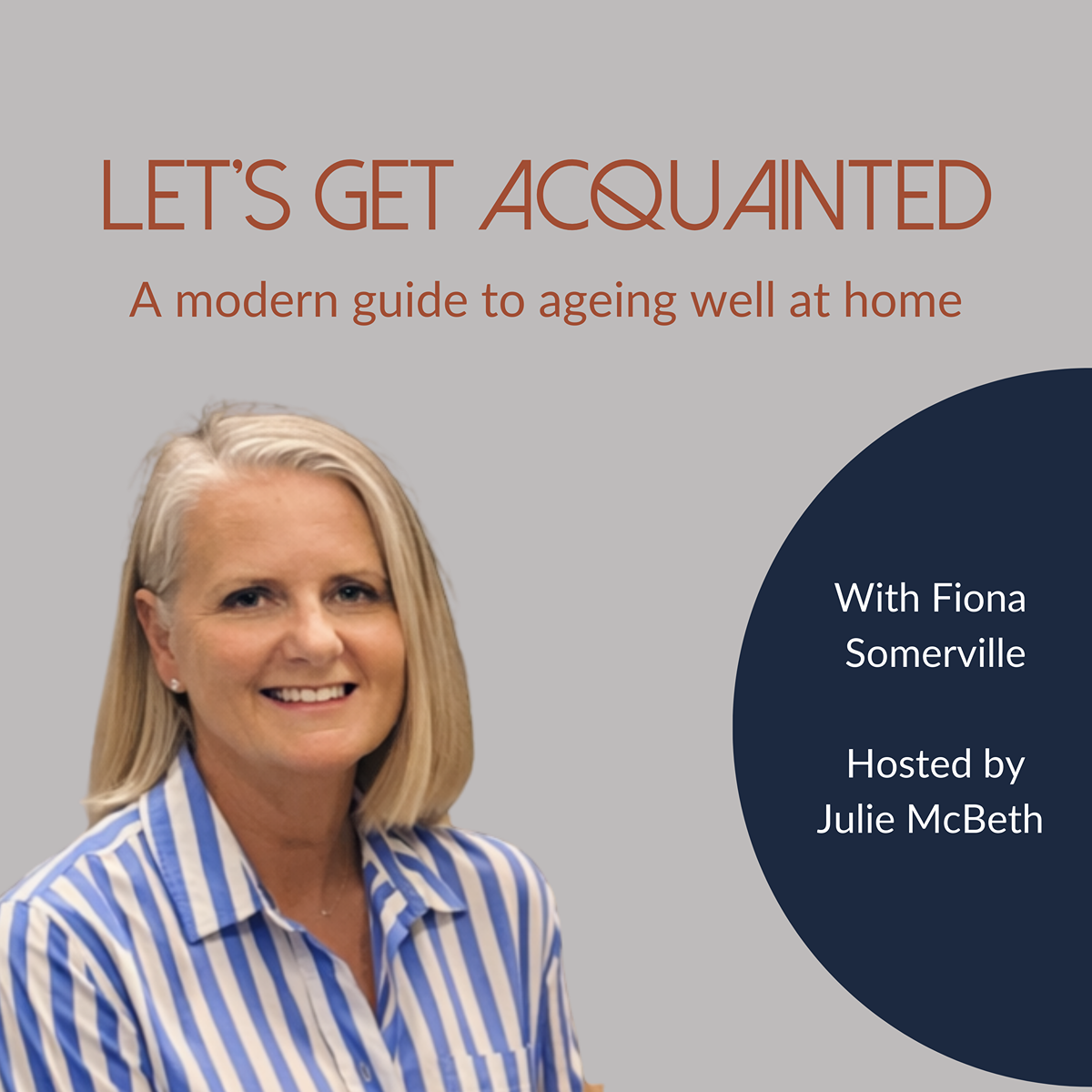
Episode 4: What we see when people start needing care
Fiona Somerville shares heart-warming stories of joy and re-ablement. Discover how premium care helps clients stay CEO of the house and spring back to life.
Across the first three episodes of Let’s Get Acquainted, we explored the systems, costs, and the swan-like coordination behind premium care. In Episode 4, the conversation shifts to something just as important: joy.
Aged care is often discussed through funding models and logistics, but the real story is much more human. It’s about dignity, connection, and helping someone continue living life on their own terms.
Host Julie McBeth speaks again with Fiona Somerville, Managing Director of Acquaint, who shares the moments that remind her why staying at home is worth fighting for. From reconnecting with long-lost friends to supporting independence after illness, this episode shows what happens when care is designed to enhance life, not just manage decline.
Why joy is a lifeline
Ageing well isn't just about being medically supported; it’s about having something to look forward to so life doesn't feel like the same day on repeat. Fiona shares how support became an absolute lifeline for a lady in Melbourne's eastern suburbs, helping her get back to her favourite Chinese dinners, local markets, and even visiting a cousin she hadn't seen for two years.
The power of re-ablement
Fiona believes great care should help people rebuild confidence. She shares the story of a client whose family thought 24-hour care or a nursing home were the only remaining options. Over time, the Acquaint team helped build her capacity, so she moved from full-time care to just eight hours a day. As Fiona puts it, it’s easy to plonk someone in a chair, but the real value is taking the time to help them keep using their legs, because if you don't use it, you lose it.
Staying the CEO of the house
Staying at home means care adapts to you, not the other way around. This is brought to life through a client in her late nineties who remains very well put together and insists on a meticulously colour-coded and numbered wardrobe. For her, dignity is found in the details: no hospital teacups, no plastic thermoses, and staff who wouldn't dream of wearing a t-shirt to care for her.
Familiar passions don't have to stop
People don't stop being themselves because they need care. Fiona shares stories of:
- A mad keen golfer living with dementia who still visits the club to interact with his mates.
- A former rider paired with a carer who teaches dressage, leading to best days spent at the riding school.
- Fashionistas who tjush their wardrobes for the new season with staff who share their eye for retail.
Throw the chicken over the fence
Real care requires patience and a sense of humour. Fiona tells the story of a fiercely independent client who changed her mind about where she wanted to live at the 11th hour. The team went into action stations, installing safety grab rails by 4:30 PM that same Friday.
And then there was the client who locked the gate and yelled for the carers to just throw the chicken over the fence; a situation handled with calm problem-solving and a few extra keys.
The best care restores confidence and protects identity. It’s about more than just meeting needs; it’s about making sure that home remains the place where you are in control.
View the full transcript: Episode 4
Welcome to Let's Get Acquainted, a modern guide to ageing well at home. We've spent the last few episodes talking about systems, money, and how to set up quality care.
Today we're talking about the joys of staying home as you age. So it's not just about the practical or financial reasons, but the human ones, the moments that make staying home worth fighting for. I'm your host, Julie McBeth, and I'm joined again by Fiona Somerville, Managing Director of Acquaint.
Fiona, let's talk about joy. Absolutely. We all want a little joy in our life, and particularly as we get older.
I'm just wondering if there's some moments that have surprised you over the years where you had some care that led to something better than expected. Actually, I've got an example, and it's a funny one. It's actually not about ageing, but it was really surprising and absolutely joyous.
So we looked after a lovely young lady who'd had some major, major surgery. Oh, right. And we were looking after her, keeping her company in hospital, and we went home and looked after her for a few months after her procedure.
And we were there 10, 12 hours a day. Absolutely loveliest girl, and her mum and her dad. She's probably in her... maybe in her 30s.
Gorgeous. She was so thrilled and so impressed with the care, she's now doing nursing. Oh, wow! That is a surprise and joy.
It was so thrilling to hear. It's like, oh, OK, there's a good result. Yeah, absolutely.
So she was so surprised by the level of care that she was receiving. Well, it was the difference. The difference, yeah.
Absolutely. And so gorgeous. So, yes, while not at the older end of our clientele, it was still a delightful story.
I think it's also good for people to know that you don't necessarily just look after people who are older. No, no, no, we have plenty of clients, yes, with medical issues or for whatever reason they've needed some additional support at home. So, yes, we certainly... We're not age discrimination.
That's right. You can be as young as you feel. Exactly.
So have there been clients who have become more active or engaged after care began? So many clients. We see this every single day. Yeah, one... I guess one example that springs to mind is a lovely lady in the eastern suburbs of Melbourne.
She lives alone and her son lives interstate, so she's got limited family supports in Melbourne. He's down really regularly and that's fantastic. But as she has, I guess, got older, it's been harder for her to get out and about.
And so since we've been engaged with this particular family, this lady's been getting back out to markets, back out for her favourite Chinese dinner, out to parks and reserves out in the outer eastern suburbs, out to visit friends she's been across town, to visit a cousin she hadn't seen for two years. Oh, wow. So for her, this has been an absolute lifeline.
And every week she comes up with other ideas, which is really fantastic. She's like, right, okay, now I know we can do this, let's do that. Let's go.
That's fantastic though, isn't it? And particularly people that she hasn't seen for years. Yeah, and the staff can see it in her demeanour and her enthusiasm for how she's approaching her day. Yeah, I think that for older people, loneliness is such a big thing, isn't it? So to know that someone's coming and there's a potential for an outing, you know, that's fantastic.
And seeing old stallholders that she used to see at the market. So it's not because her social circle isn't around anymore, it's really because she hasn't been able to see them. Well, that's amazing.
Other examples where, you know, families have said, we don't think this is, let me ask that question again. Other examples where families have said, we don't think, we didn't think. Why am I stumbling over this? These aren't glasses.
Are there any examples where families have said, we didn't think this was possible anymore? Again, every day. I've got a feeling that every question you're going to ask me today, I'm gonna have an answer. We get so much joy and satisfaction out of some of the stories we get from our clients.
We're, and I am just going to think of particular people in different scenarios while we're talking today. One that springs to mind is one lady that the family thought it's aged care or it's 24-hour care and that's it, and that's the end, you know. Yeah.
Here's where we are. She was quite ill for quite some time. We've worked with them for a long time now and over a fairly lengthy period, we've actually got the care hours down to a whole lot less because we've been able to work with this woman, build in greater capacity for her to be able to manage her day.
Build in support. So we did start with 24-hour care. We're now there just eight hours a day.
Which is incredible. So she feels like she's got, you know, a lot, freedom's a tough word to use, but she's got more control over her day. Yes.
And she's got the support and the company and the team that she really loves and trusts. And that has made the absolute difference between her staying at home or moving into aged care. And that's great that there are people who go from that full 24 hours.
And the family didn't think they'd get there. They just thought, oh yes, well it's 24-hour care for the rest of her days. And it's kind of worked out differently.
We're also getting her away as well. She's getting out for trips to visit family and things like that. So it's been fantastic.
That sounds so good. It just, sometimes for people, you know, it's just when they get a little bit of care that they do kind of spring back to life. It's like they're not just lying there in a solitary room.
It is about re-ablement and supporting people to be able to do things that they should be doing. So it's easy to plonk somebody in a chair and bring everything to them. It's a lot harder and it's a lot more time consuming to walk somewhere somebody, it's a lot harder and a lot more time consuming to walk someone from one room to the other.
Yes. But that effort's really important because you keep using your legs. If you don't, you know, use it or lose it, as they say.
So the more you do, the more you look after yourself. That's right. And I remember, I'm sure many people listening have had experiences with their grandparents or parents where they've gone to a nursing home situation where people are just sitting around all day, maybe just watching television and it's a really sad kind of situation.
I remember my nana being so excited to see us and the people were just like, wow, you're really blessed to have so many grandchildren coming to see you on a regular basis. Yeah. But this is kind of- It's the everyday.
It's the everyday. And it's that they've got something to look forward to as well. It's not the same day on repeat.
Yeah, that's right. Yeah, that sounds great. And Fiona, I know your service is amazing, but we all want to know, have there been some times when things have gone off the rails and you and your team have recovered brilliantly? I'm sure this happens too.
It happens, yes. We had one client who was interesting, shall we say. He had a number of properties that he used to reside in.
So one day he'd been in hospital for quite some time and was going to one particular property which was completely set up for having him come back home and everything was in place. And at the 11th hour, he decided, I don't want to go there, I'm going to go to this one. So on a Friday afternoon at about two o'clock, we got the word that it wasn't property X, it was property Y. So we had to completely- Action stations.
Yeah, inform the team that, no, you're not there. Are you able to go to this property? And that all worked out, that was fine. But we also got there and realised that the bathroom wasn't suitable in this particular instance.
It had been prior. So we arranged to get somebody in to check out the bathroom and instal grab rails to make it safe. And that was done by 4.30 that day.
Oh wow. So it was, yep, we can do it. That's not how we like to operate.
We like to plan for things and we do and we had everything planned. What we hadn't planned for was that absolute, change of mind. I'm not going here, I'm going there.
Okay, sure. And I love that you just rolled with it. You didn't say, no, no.
No, the answer to most things is yes. That's right. That's fantastic.
Unless you want to go skydiving, but the answer is generally for most requests is yes. Absolutely. So what are some of the small everyday moments that you've witnessed that remind you why this work really matters to people? Look, some of the really simple things are when clients just talk about their day and they're smiling and they're recanting stories either to their family or talking to us on the phone.
Yeah. Or talking to their staff and saying, this was amazing. We've got one client that he's at home living with dementia, incredibly forgetful.
There's a lot of support in place to keep him safe. But every single day he's out and he's doing something interesting. He's engaging with his friends.
But he also gets to go to the golf course. And that gives him, he's not playing 18 holes, these days by a long shot, but he gets to go. He gets to interact with his friends.
He has a ball. He then talks about all the stories and the awards that he's won and things like that. So that's fantastic because that's about, this is what's important to you, like total mad keen golfer.
Yeah. And used to play two or three times a week at minimum. And so golf is important and getting him out and meeting his golf mates and out in his golf outfits and things like that, even though he's not playing.
He's still really. And in familiar surroundings with people that he's met with many times. So it's not the big things, it's the hundreds of little things.
Yeah, that all add up and make it a joy. So tell me about a morning or an afternoon that was actually extraordinary because someone got it right and your clients and their family were really chuffed. Again, happens a lot.
I'm gonna be saying that on repeat. That's good though. Look, I'm thinking about one lady that we support.
She actually lives in an aged care home and her family are in some very busy jobs, executive roles. And some of the family aren't even in this state. So, but they completely adore their mother.
So we go in a couple of times a week for about seven hours. We take her out or I start to take her out, her team. And she loves shopping.
She loves even going to the butcher that she used to go to all the time just to say hi. One day, one of the staff took her into a store and it was about just seeing that familiar store owner that she'd bought clothes for years and years and years. And yes, they might have bought one or two things.
But they also, it was again, just the experience. So the thing that gave her joy and the thing that our staff noticed was just the look on her face when she's touching and feeling the fabrics in the store because she just loved fashion and having that lengthy conversation with somebody that she'd been buying clothes from for years and years and years was absolutely beautiful. And then taking her to her favourite restaurant for dinner, the staff know her, they get the food ready, they know what her order is, the glass of Merlot sitting there, it's all perfect.
And she turns around, she goes, this is the best day I could ever have. And she would say that every week because she'd be out doing lovely things. But it was just so delightful and so rewarding for staff and also for the family to know that their mum had a fantastic day.
Yeah, absolutely. I love that you guys also go into some of the... Aged care. Aged care facilities.
Homes wherever home is. Absolutely. So we'll go in there as companions and we're not replacing the work that aged care homes do.
They're there for a really important reason, but we're there to add a little bit extra to somebody's day. A little bit of joy. A little bit of joosh, if they so choose.
That's fantastic. And talking about... Actually, my next example's aged care ones. Okay, good.
So what are some of the things that people get to keep doing at home when they... What they... Oh gosh. What are some of the things people get to keep doing at home that they might lose in residential care? I'll do that again. So what are some of the things that people get to keep doing at home that they'd lose in residential care? I think some of the things that people get to do is maybe just doing things a little bit differently.
So in residential aged care, particularly in some of the more modern homes, they've got incredible facilities for people. They've got cafes, they've got... Everyone's got a hairdresser, but they might have a pool, they might have a gym, they'll have a movie theatre, things like that. And that's absolutely brilliant.
But again, sometimes some of the differences are we'll actually take somebody out of residential aged care and we'll take them to the movies. So they will go. They will get to have their cup of coffee or they'll get to have a choc-choc.
Yeah, whatever it is that they want. And enjoy the movie and then maybe go for a coffee or lunch afterwards or what have you. So it's actually... And it's one-on-one.
It's like going to the movies with a girlfriend or something like that. But it's more than just sitting there in a room and watching a movie. It's a bit like if you watch something on the telly at home, but you go to the movies.
Sometimes you really wanna see things on the big screen and you wanna have an afternoon out or an evening out. It's much more fun. Absolutely.
So it's enhancing. And how do you see people, clients or families just really light up when care is working well at home? Look, that again is something... I think the common theme there is freedom. Yes.
So, and again, another example, and this is one we do deal with an awful lot is where we'll have a couple. One of the couple is living with dementia and the other person is supporting them. And they're often very similar ages and really doing their absolute best, but they're on 24 hours a day.
And it's a really tough gig. So we've had clients where the spouse, the wife, let's give one example, has been able to get out and go to classes or go play bridge and meet the girls for lunch and do things like that without having to worry. And then because we've had a very dedicated small team going in on the days that they're required is that the client has then got to know them really well and they've got out and about and done things differently.
They're just not talking to the same one person all the time as well. So a walk around the tan or a trip to Carlton to get their hair cut or, because that's where they used to go for 20, 30, 40, 60 years or what have you. So those things then makes everything lighter for the spouse as well.
Yes, they've both been out for the day and then they can come back and talk about what's happened. And then you've got some happen to chat about something different, but it's also taking that worry away. Absolutely.
Now I think we will sort of move into these, maybe some stories where there were really unexpected moments. What was a moment between a care and a client that really struck with you? Look, I think there's moments every day that we hear about, but one example, and I think we have talked about this before, we did have an absolutely beautiful client who has since passed away. However, she used to ride when she was a lot younger and our staff member teaches dressage.
That was an intentional pairing, which is really important. Part of that pairing that we do is around skillset first, but then obviously likes, interests, what people have in common to make that more enjoyable. And our staff member took this client up to the riding school to meet one of her favourite horses.
And they did that a few times. They had the best days. That's fantastic.
Which was just delightful. And she obviously just was happy to be around the horses and in that environment that was familiar to her. Yeah, absolutely.
But as you say, it's that moment between the carer and the client where they're both enjoying the day. Exactly. And it's around that thoughtfulness and consideration of what is going to bring somebody joy, what is important to that person.
It's not about ticking a box and just saying, oh yes, they've got up, they've had a shower, they've had breakfast. That's right, because the carer obviously thought about this. Yeah, and talked to us and we helped coordinate everything and made it happen.
Yeah, I think that's great for both. And everyone was thrilled. Absolutely.
So now, tell me about something that happened that you didn't expect, a moment of humour or perhaps something that reminded you of why people staying at home really matters. Yeah, look, I'm just thinking of one particular client. She is, look, everybody says, my mother's fiercely independent.
This woman is so fiercely independent and she'd been really, really sick. In fact, so sick, she was living on her own and she was actually found on the floor by the ambulance and what have you, and ended up in hospital for a really long time, ended up in aged care, but came home. And on top of a number of medical issues and ageing and some cognitive decline, she also had some mental health issues as well.
But some of the stories, the staff would come back and she would lock people out of the house or she'd lock the front gate and you couldn't get in and she'd be yelling over the fence, just throw the chicken over the fence. People would go shopping. And so the day that we could actually get in with the roast chicken was kind of helpful compared to the thought of throwing a roast chicken over the fence to her is probably not how we roll.
So yes, we've had certainly some unusual and unexpected moments that you've just got to deal with them and so the staff at the time rang and said, okay, this is what's going on. And we kind of worked through that and we got to a good outcome in the end. No chicken over the fence.
No, got some extra keys.
Has there been, I'm sure there's been many times where families tell you that something's really changed for their parent or loved one since the care happened? Often we see that families and our clients, they become more relaxed. When they get to know us and the team, there's a huge level of trust there and they really find that they can do more and the relationship's really good because again, coming back to that matching process, that's really important.
So it's a lot more high touch and it's a lot more close. That's great. So after all these years, what keeps you so passionate about keeping people at home? Well, I think it's stories like this.
I keep recanting these stories and I'm like, oh my God, what amazing clients. It's knowing that we can make a difference and we do make a difference and that people are so happy and have got the best outcome that suits them at the time. So it's very situational, but it's really the feedback that we get from people and the word of mouth.
And I was chatting to a lady the other day, she's 90 odd and she said, oh God, darling, I'm telling everybody about you. And she goes, and you know, I know people. She was just a cracker.
That's great. Great word of mouth. We love that.
She's very cute. That's good. And just with people, you know, you say staying at home means that they are the CEO of their own home.
And that's, I think that's a great way of putting it, that their life continues. They're in charge and in control of everything, but they've got this support that enhances their life. Yes.
Look, one of our longest serving clients, or we're serving them, she's been with us from day one and she's in her late nineties now. And very, very well put together, very socially connected. Everything has to be just so.
Obviously over the years, she's slowed down considerably, but her standards are maintained to the nth degree. And she's absolutely delightful. I shouldn't say we have favourites, but we have lots of favourites, but she is certainly one of them.
And it's around maintaining those standards and that dignity. Yes. It's really important.
What kind of examples have you got? Oh, anything from, you know, she gets the wardrobe rearranged for each season. All of her clothes are numbered and colour-coded. She's got this amazing system.
I'm very jealous of it. So am I. And everything is just, look, I guess it's like us. It's quality over quantity.
Yes. And that's how she lives her life. Everything is about quality rather than quantity.
So there's, she likes food to be, you know, really well prepared and really well presented. You know, so there's no sloppy. Good cutlery and property.
Yeah, there's no hospital teacups or no plastic thermoses and things like that. Even the staff, nobody would dare wear a t-shirt or anything like that to go care for her. One of our requirements with staff is, we talk to them and we say, look, they go, do you have a uniform? No, we don't.
But what we do is talk about our clients before we've even introduced somebody and talked about how they are as a person, but also what they expect. So we kind of expect people to be in line and be sympathetic to what that client wants. So the twinset and pearls type, you'd amp up your presentation and then you've got sometimes the younger ones, like that girl that's going to do, or is doing nursing, you could probably be a little bit more relaxed with her.
Yeah, as you say, it's about making that connection to what the people want, the clients want, and making that perfect match. And if she wants to spend money on more expensive butchers and grain grocers, that's her choice. We're not going to say, oh no, you've got to go shop at this place because it's cheap.
No judgement. And sometimes you do see that. You see people saying, oh well this is the cheapest, you should have this.
Well, not if they don't want it. I just think it's so amazing that people have been able to just live out their lives in the way that they have lived. And so thank you so much for sharing these stories, Fiona.
It's been a fantastic conversation. I think they remind us that what we're really talking about is aged care, is people's lives. It's not about packages or things that, what most people look at.
It's about really caring for people at that stage of their life. It's genuine choice and control over their lives. So that's much more powerful.
Absolutely. Well, thank you for listening to Let's Get Acquainted. In our next episode, we're going to talk about how life doesn't stop just because you need care.
And I'm sure there's going to be some more special moments that we can share, Fiona. So we hope that you can join us then. Thanks for listening to Let's Get Acquainted.