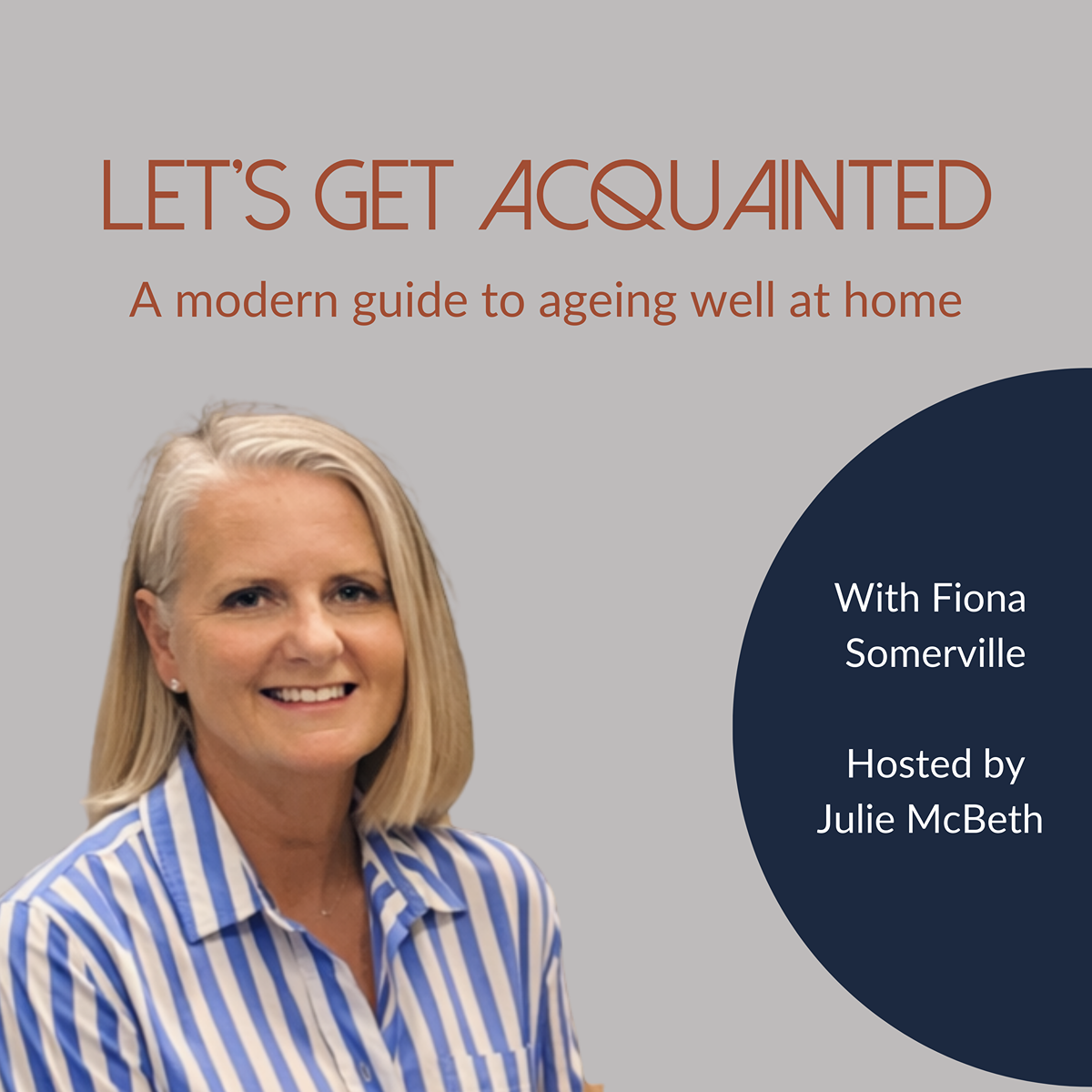
Episode 5: How families make good decisions
Fiona Somerville explains why help actually increases freedom. Learn how private care empowers clients to stay socially, culturally, and professionally active.
There’s a common fear that once care becomes necessary, life inevitably shrinks. We imagine needing support means staying home, giving things up, and becoming small. But it doesn't have to be like that.
In our final episode of Let’s Get Acquainted, Julie McBeth and Fiona Somerville challenge that assumption head-on. Instead of seeing care as a restriction, they explore what happens when support is designed to create more freedom, not less. From theatre nights and holidays to board meetings and beloved routines, this episode focuses on living fully while receiving help. It’s a practical guide for families who want to make good decisions without sacrificing identity, lifestyle, or joy.
A new lease on life for the household
When families first bring in support, often with great reluctance, the immediate benefit is often felt by the spouse or primary carer. Fiona explains that when quality help arrives, these partners finally feel recharged. It’s the relief of realising, "I didn’t realise I could actually do this". For many households, help doesn't take something away; it gives a healthy relationship dynamic back.
The sky’s the limit
People’s lives don’t fit into rigid, prescribed aged care service lists. Fiona contrasts private care with systems where every change requires a bureaucratic reassessment. In a responsive model, when a client asks to do something, the starting point is: How can we make this happen?
- Extending a Friday shift because someone wants to head off to Hamer Hall or a show.
- Keeping clients engaged in theatre, opera, and singing.
- Adapting to needs immediately without waiting for government reassessments.
Identity doesn't retire
Another powerful insight is that people remain themselves, regardless of age. Fiona discusses clients who are still connected to the businesses they built, their babies, attending board meetings or visiting the office to stay involved, even if they aren't the main decision-makers anymore. Professional legacy and purpose remain deeply meaningful.
Apres-ski and staying vibrant
Ageing doesn't mean becoming invisible. Fiona shares the story of a vibrant client in her 90s who travelled overseas with her family to the mountains. While her family outraged her by saying she couldn't go skiing, she happily agreed as she said she did apres-ski very well. Whether you're in your 60s or 90s, everyone is an individual with a different situation.
The CEO of the house still calls the shots
At Acquaint, the care is built around the client’s life, not the other way around. As the CEO of the house, the client calls the shots on what suits their household and lifestyle. This includes preserving the routines that maintain health and momentum. As Fiona notes, when it comes to physical and mental limits, it’s a case of use it or lose it.
Cats and cuddles and real relationships
Thoughtful care is never transactional. Fiona recalls a client who, while heading back to the hospital, asked a staff member to stop by her apartment not just to feed the cats, but to stay and play with them for a little while. Because the staff were perfect matches who really liked cats, it was a joyous moment of understanding what mattered emotionally.
Choosing care isn't a one-time event; it’s an ongoing process of communication and adaptation. By monitoring every shift and constantly reviewing goals, families can ensure that care remains a tool for liberation.
View the full transcript: Episode 5
Welcome to Let's Get Acquainted, a modern guide to ageing well at home. There's this assumption that once you need care your life shrinks. You stay home, you stay safe and you become small.
But it doesn't have to be like that. Today, we're talking about clients who still go to the theatre, visit galleries, meet friends for lunch, people whose lives continue with support. I'm your host, Julie McBeth, and today I'm joined by Fiona Somerville, Managing Director of Acquaint.
Fiona, let's talk about living, not just managing. Oh, what fun. So what does it look like when care empowers someone to live their life? What we see a lot of, particularly when people start to take on care, and often it's with great reluctance, because they've managed all their lives, they've been able to cope with anything.
But what we do see very frequently, particularly in spouses where somebody is being the main carer for their partner, is that we just see that the carer is relieved. They feel recharged more than anything. That new lease on life, sort of help has arrived.
I didn't realise I could actually do this. Even though we all know that there's all this support out there, a lot of it, I think people feel it's very task-oriented and getting that absolute flexibility and working with someone around what suits their household, their lifestyle, their needs is really important. So we see people, it's almost like they've got a new lease on life.
And you've got many examples of clients who are still actively engaged in their interests and passions. So tell us about some of those. Oh, look, we frequently get little notes and emails saying, oh, can we extend Friday's shift because so-and-so's got off to Hamer Hall or off to this show, and could the staff member please go with them and stay? We've got other clients who might book in a regular shift, but then they want to do something else, go for a drive, do whatever it might be.
And they're constantly coming up with new things to do. We've got other clients, we've had people that work in the arts, I'll have to keep this as broad as I can, and we've kept them engaged in their communities in terms of theatre, opera, singing, all sorts of different things. Exactly, and as you say, keep them living their lives.
If you're passionate about your interests and you have been all your life, why shouldn't it just continue to be that way? Don't give up. It's not worth missing out. No, absolutely, don't give up.
I love it. So how does premium home care make this possible where some other models don't? Look, we're really about the flexibility. So working with our clients and being able to adapt.
When we get a question, typically the answer is yes, and we'll make things happen. So we then look to, okay, somebody wants to do X, Y, Z, how do we facilitate that? And so it means that clients are coming to us more with things that they want to do rather than having to work within a prescribed list. And also now with the changes to supported home, which is a very important programme, there is going to be delays in making those changes.
So in a private service there's a lot more flexibility and adaptability. You don't need to have a reassessment to then have a change to your care plan. So if all of a sudden you've had a prescribed list of this is what's going to happen under the supported home programme, for example, and you want to do something different, if it doesn't fall within your prescribed care plan, it's going to be a lot harder to have that happen quickly.
Right. But I mean, that's the same with everything, isn't it? You just have to have more flexibility. And work within what you've got.
Yeah, absolutely. So with us, it's very much, yep, sky's the limit. Well, let's work out how we can make this happen.
And invariably, they're not hard requests. They're not hard. They're just people wanting to live their lives.
Let's dig a bit further with that. Tell me about some clients who still go to the cultural events like theatre, opera and galleries. How does that work? Easy.
So one client, she's fantastic. She's late 80s. She lives at home alone.
Her daughter travels a lot for work. And the client actually messages us on the app. She's pretty good on the phone.
She'll ring. She'll also ring, but she will often just send a little note on the app and just go, by the way, you know, I've got this happening on Friday night or Sunday night or whenever it might be. Could Natalie stay a bit later? Great.
And then we just talk to our staff and go, look, this is the plan for that night. Are you okay? Just let us know, you know, when everything's done. That's great.
And the staff member takes them there and is with them? It depends. It depends. So some staff will take somebody and drop them off and go maybe do some other errands or go home and do some cooking or do something else and then come back and pick them up.
And in other instances, our staff are going there with them to accompany them to a show or to a movie. Fabulous. That's a great job, isn't it? Oh, yes.
You've got to be very good to get a job. So just be very careful there, Miss Julie. I might apply.
You might. Off to the Melbourne Theatre Company or different events. Sounds fabulous.
The ballet. Ballet is good. Ballet is good.
Running a service like this, you know, there must be some unexpected moments. What are a few of them that still make you smile? Some of the moments and some of the comments and some of the reports that we get back from staff. And one of my favourite ones was with a client that had just come out of hospital and the staff member did say to them, why don't you just have a little snooze? And the client just turned around and said, I don't want to miss any time with you.
And it was just like, oh, that's so cute. It was just lovely. So it's that, you know, the small teams, they know our clients really well.
It's a very close relationship. There's a really good relationship with us and the clients know that we deliver. So have there been requests that have made you stop and think and say, well, that's a first.
There is nearly every week. We did have one lady who was a middle aged lady and she'd had a serious medical procedure. So we looked after her for quite a long time, a few months.
And at one point she ended up having to go back to hospital. We were constantly liaising with her team there and taking her back in for appointments. But at this time she wasn't very well and needed to be readmitted.
And we were providing 24-hour care. And I remember at one point after she got settled into her room and we'd established that everything was going the way that we needed it to be going. And we'd talk to her and she just rang the office and she said, oh, can you get so and so to maybe on their way in to come and see me? Could they call by the apartment, feed the cats, but could they just stay and play with them for a little while? And luckily, I mean, we knew she had cats and we had to make sure that the staff that were going there liked cats, but like really liked cats, like liked F1, liked cats, liked this, liked that.
It was really funny, but it was so cute. I had to ring the staff member and go, you've got to go and cuddle the cats for a little while and then call into the hospital. So it was so cute.
Cats and cuddles. And someone like me, who's so allergic to cats, I love them, but I couldn't have done that. So it just, as you say, it's the perfect match.
You'll always find someone who really gets it and wants to play with the cats. Beautiful. So without naming names, of course, we know you're incredibly discreet.
We never name names, but what's the most unusual day you've seen unfold through care? Oh, look, all sorts of things happen. I know we had one client at the very last minute. He was desperate to book a little holiday with his girlfriend, so we had to arrange that little trip and organise things for him to make that happen.
That was cute. Yes, you sort of don't imagine older people having those kinds of relationships where they want to go away with the girlfriend. Oh no, they do.
And you need to respect that. It's an important part of people's lives. Where was he off to? I can't tell you.
I'd have to kill you. That's right. And what about the carers? What role do they play in making these outings possible? Do they sometimes even suggest things? Look, they'll talk to us, so we get very detailed reports on every shift.
So all services are coordinated and led through the team at Acquaint. So we've got registered nurses, so we've got clinical expertise. So there's often a lot of reasons why something may or may not happen.
That's really important. So staff know to talk to us rather than directly suggest something, because sometimes that can put people in an awkward position or it can have other consequences. So we then talk about things and then we'll liaise with the client and or their family, depending on how the relationship is structured.
And then we just make sure that there's no detail left to chance. So very clear in our communication and feedback and things like that. So that's great.
And how important is it for people to still feel like themselves and not just someone who needs help or care? Well, that's the most important thing. The absolutely most important. It's not just somebody who needs help.
We've had people who have moved from a residence, they've moved from a retirement village to somewhere else, or they've moved from residential aged care back home. We've had people be long-term in hospital and then come out and think, oh, we're not going to be able to cope. But they do.
And with enough support, they absolutely can. So everything is focused around the client and what their needs, wishes, desires are. So we start with that.
We start with safe. We work our way out. So it's really important to make sure that we've got all the structures, all the systems, the processes to keep someone safe and supported at home.
And then we make sure that we do everything that we can to enhance the relationships and enhance life. Yes, absolutely. As much or as little as people want.
And everyone's different. Some people like to have somebody in the house, but not see them. I want to know that they're there.
Don't be in my face all the time. That's really important. And then you've got other clients that need someone to be with them, almost next to them 24 hours a day.
So we have to look at how we structure that. Yeah, and as you say, you've got all different levels of care as well. So it can be changed and you can determine what's the next phase.
So some people, their identity is just wrapped up in being elderly. And why does it matter then for these moments for people as they age? Because I guess some people going through life, they have a youthful aspect. But other people want to be kind of very, consider themselves old before their time even sometimes.
Well, I guess, look, age is just a number. It's as old as you feel. You know, we've got incredible clients.
We've got so many that are living in their 90s, and the reason they're in their 90s is because they're living well and they're enjoying life and they're staying socially engaged, they're eating well, they're looking after themselves and all that kind of thing. And one client, the other week she cracked me up because she'd just been away on holidays with her family, and she had been overseas in a particular area that might have white stuff on the mountain, and her family, she was outraged, her family told her she couldn't go skiing. But she did agree.
Yes, maybe it was time. She did apres ski very well. She was good at the apres, yes, correct.
But very vibrant, you know, very engaged. We've got younger clients that are very, you know, you would think that they're in their 90s and they're in their 60s or 70s. So, you know, we come back to that, everybody's individual and everybody's situation is very, very different.
And I just love that people are still going to places with white stuff on the mountains, to be able to just be in that environment where they're comfortable and they have lived a lot of their life going away on those kinds of holidays.
Oh, the stories. Some people, some of our clients have, is just mind-blowing when staff are either sitting and chatting with them or we're talking to them or even sometimes when they just ring up on the phone.
Some of the gifts, we have one client, she actually booked in extra time with one of our staff because she wanted to personally have her carer bring her to the office to give one of our colleagues a gift before she went on an overseas trip. And it was a book about a certain area in Italy that our staff member was going to and this client had been to and had met the owner of the same property and what have you and it was just beautiful. You're building real relationships with people and they're in their homes, you're with them in these moments, it's really great.
And we've had clients, they mightn't be involved in running their businesses anymore, the businesses that they've created and incredibly successful companies and they may still go into the office and do some jobs or they might attend board meetings and we'll facilitate them attending and going and making sure that they're still engaged with the business. Now at the end of the day they mightn't be the main decision maker but they're very involved, it's their baby. And I mean this is like routines for people, why are they so important to maintain these types of routines as people age? Well it's easy to stop doing things, it's a lot easier to stop things and it's that old adage, use it or lose it and the less you do the less you want to do.
And we see that even with a short trip to hospital, it takes older people a lot longer to recover from either an illness or surgery or for whatever reason has brought them into hospital. So getting that recovery, a little bit of enthusiasm around getting back on track again. Look at the end of the day as we age things don't work as well as they used to many years ago, things ache.
We know that now. I know that. But we can still do as much as we can safely do and keep things going.
And I guess with routines it's that familiarity as well that helps people to get through their days, they've got a certain way of doing things as you say, popping into their business that they started, things that are just normal parts of their life, the more yet they can continue to do that. Exactly. Even going for a walk, going for a walk through the park and stopping and sitting on a chair and then standing up from that chair, you're doing exercise.
You're using your quads, you're moving and you need to keep moving for as long as you can. I have a note to self. Yes, exactly.
Take the stairs. We all know that. All that stuff we do, everyone needs to do it to whatever physical limit or mental limit that they can achieve.
Yes, absolutely. So how do you build care around someone's life rather than building the life around the care? Well at the end of the day our clients pretty much, they call the shots. So we're constantly adapting to what suits them and their household with an overlay of what is possible, what is safe, what is agreed in terms of their goals and their care requirements.
So it really is very much completely tailored and completely adaptable. I guess that whole assessment area is something we haven't really gone into a lot of detail about, but you do all of those things at the beginning when you first get a client. And constantly, all the way through.
It's ongoing. It's an ongoing process. It's not necessarily.
We get a lot of feedback in multiple ways every single day and that's really important. So before we even start services for a client, we've spent a lot of time with them, understanding their needs, understanding what's going to work best, understanding communication channels, understanding all sorts of things, kind of planning for what we think is most likely to transpire and then constantly reviewing and adapting and talking to people. So it's communication, communication, communication, communication.
And as you say, ongoing, so that it's being monitored all the time by the people. Always. Every single shift.
Thank you once again for coming in. I think this is such an important message that care should be something that fits in with people's lives and gives them a better quality of life as they're ageing. For someone who's listening, who's worried about needing care and giving up things, what would you say? I'd say that getting help actually gives you more freedom.
Absolutely. Much more freedom than you think. Well, thank you, Fiona.
Thank you for chatting with us today. And this has been Let's Get Acquainted, a modern guide to ageing well at home. Thank you for listening.